
The Union Budget on Sunday proposed a tax holiday till 2047 for foreign companies that provide cloud services to customers globally using data centres located in India, signalling the government's push to make the country a major hub for AI and digital infrastructure.

The Securities and Exchange Board of India (Sebi) is set to introduce key reforms aimed at facilitating smoother mega initial public offerings (IPOs). Key among the proposals is a reduction in the quota reserved for individual investors - those applying for less than Rs 2,00,000 per application - from the current 35 per cent to 25 per cent for large IPOs (issue size above Rs 5,000 crore).

The 12-month programme is expected to offer shorter internship duration in the third phase of the pilot in certain sectors such as services.

At present, e-mobike penetration in India is close to negligible, unlike the scooter segment, where electric scooters account for nearly 20 per cent of sales.

'It's a very, very large opportunity -- not just for India, but even for Uber globally.'

The fiscal tilt towards capex benefits companies in investment-related sectors like capital goods, defence equipment, engineering & construction and metal & mining. The planned cut in revenue expenditure will weigh on companies in consumption sectors like FMCG, consumer durables and retail.

'This Budget has a one-year agenda, which you can call the sprint, and the marathon is towards Viksit Bharat.'

The Centre has notified the Scheme to Promote Manufacturing of Sintered Rare Earth Permanent Magnet (REPM) with an outlay of Rs 7,280 crore. The initiative is targeting to reduce dependence on China for critical inputs and secure supply chains for EVs, electronics, aerospace and green energy.

Here's a quick look at the Bollywood movies list of 2026. Lots of interesting titles and genres coming right up!

Sunil Bharti Mittal-led conglomerate Bharti Enterprises and private equity firm Warburg Pincus will collectively acquire a 49 per cent stake in Haier Appliances India, the local unit of China's Shandong-based Haier group, for an undisclosed amount. The transaction, according to industry sources, values the company at about 15,000 crore.

Companies would have to recognise the increase in gratuity liability arising from new labour codes in their interim financial statements and results for the period ending December 31, the Institute of Chartered Accountants of India (ICAI) has said in its FAQs on the new labour codes.

India is set to take its first steps towards its own human space flight when the uncrewed Gaganyaan mission soars to the skies later this year. Private players in the space sector are also gearing up for launching satellites on home-built rockets.

The government has no say in where the country's refiners source oil from because these are commercial transactions.

India and the European Union are set to announce on January 27 the conclusion of negotiations and finalisation of a free trade agreement, which is aimed at boosting economic ties between the two regions amid disruptions in global trade due to US tariffs, an official said.

'If we don't become part of this, if we don't embrace this particular technology, millionaire brands might go down, which we cannot allow.'

India has been on an FTA-signing spree of late. Since 2021, it has signed eight trade agreements, three of which -- with the UK, Oman and New Zealand -- were finalised in 2025 alone.
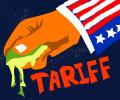
A trade deal makes sense only if it is fair and reciprocal. If the cost is strategic dependence or loss of policy space, waiting is the wiser option, asserts Ajay Srivastava.

Experts said that earmarking of funds for public health at par with national security indicates a key policy shift.

Budget 2026 sticks to fiscal discipline, shuns populist measures despite five key state elections coming up, but ends up rattling stock markets with a higher transaction tax on derivatives trading.

FDI inflows into India are expected to register robust growth in 2026, supported by strong macroeconomic fundamentals, big-ticket investment announcements, sustained efforts to improve the ease of doing business, and a new generation of investment-linked trade pacts.

India's $280-billion IT industry heads into 2026, balancing visa-related headwinds and global trade uncertainty against its biggest-ever push into artificial intelligence and the rapid expansion of global capability centres (GCCs). Heightened scrutiny of the US H-1B visa programme - including a proposed $100,000 fee for new visas and concerns over a potential 25 per cent outsourcing tax - has complicated cross-border delivery for Indian firms, even as companies accelerate efforts to reduce reliance on onsite staffing.

These upcoming launches carry added significance in light of setbacks suffered in recent years.

The latest move removes one of the key friction points for visitors, temporary liquor permits, while allowing licensed hotels and restaurants operational flexibility.

From a surge in startups to crewed mission preparations, 2025 marks a transformative year as India eyes $44 billion space economy by 2033.

While 28,141 applicants accepted internship in round one, in the second phase this was down to 24,638.

Various industry bodies have sought immediate government intervention through the imposition of anti-dumping duties, claiming India has seen a surge in imports of Chinese goods over the past two weeks.

They are venturing into allied businesses, which range from starting talent management agencies to music labels to tap into every possible monetisable opportunity to appeal to investors.

Eternal-owned quick-commerce firm Blinkit has dropped its '10-minute' delivery claim after intervention by the Labour Ministry amid growing concerns over the welfare and safety of delivery workers.

Mexico on Thursday imposed a tariff of up to 50 per cent on imports from its non-preferential trade partners, including India, a move that might hit New Delhi's annual $5.75 billion shipments to its third-largest car export market.

Maruti Suzuki India plans to localise battery production and other critical components over the next few years as part of strengthening the overall EV ecosystem in the country. The company, which plans to launch its first electric vehicle - e VITARA in the domestic market next year, is looking to instill confidence in the buyers as it looks to strengthen the overall EV ecosystem.

The sources declined to specify the number of drones the Navy plans to acquire but said the focus is now on manufacturing the MK-II in India through partnerships with Hindustan Aeronautics Limited (HAL) and Elcom.

In order to optimise branch efficiency, public sector banks (PSBs) are reworking their strategies to streamline operations and reduce cost amid changing customer behaviour. The strategies include closing or merging low traffic branches and reducing their size in smaller centres.

The US Food and Drug Administration's (USFDA)'s new draft guidelines aimed at speeding up and reducing the cost of developing biosimilars - lower-priced, near-replicas of complex biologic medicines - could significantly benefit Indian biotech companies.

While not all complaints are frivolous, experts say petitions timed close to an IPO or listing often raise concerns about mala fide intent.

Recent years have been turbulent for the insurance industry due to direct and indirect tax reforms, regulatory overhaul and other external pressures. The events cumulatively slowed growth rate to single digits from the high teens seen earlier.

'Some success has been achieved in raising the costs of terrorism for Pakistan.'

'The real story of 2025 is that India officially stopped being a 'market of the future' and started acting as the world's primary economic engine.'

India's diagnostics sector is accelerating capacity addition and geographic expansion, as large chains and regional players invest in new laboratories, integrated centres and dense sample collection networks to tap rising demand for preventive, advanced and precision testing.

Developers are entering one of the busiest construction cycles, with the top four firms planning launches worth Rs 1.13 trillion over the near to medium term, even as execution faces pressure from approval delays, labour shortages, rising costs, and contractor capacity limits across the industry.

The operator's liability in the case of an incident is limited to 3,000 crore for reactors with thermal power above 3,600 Megawatt; 1,500 crore for reactors with thermal power between 1,500 Mw and 3,600 Mw; 750 crore for reactors with thermal power between 750 Mw and 1,500 Mw; 300 crore for reactors with thermal power between 150 Mw and 750 Mw; and 100 crore for reactors having thermal power up to 150 Mw, fuel cycle facilities other than spent fuel reprocessing plants and transportation of nuclear materials.
